When The LEGO Group launched LEGO Friends in 2012, it quietly became one of the most commercially successful, and culturally debated, product lines in LEGO history. What began as a targeted attempt to broaden LEGO’s audience quickly evolved into a fully realised city system, a transmedia storytelling platform, and a cornerstone of LEGO’s modern design philosophy.
LEGO Friends is not a side theme. It is not a novelty. It is one of the most significant evolutions LEGO has ever made.

The Origins of LEGO Friends (2012)
Why LEGO Friends Was Created
By the late 2000s, LEGO faced a clear challenge:
Despite near-universal brand recognition, girls aged 5–12 were under-represented in LEGO’s customer base. Internal research revealed that while many girls enjoyed LEGO as a concept, existing themes often failed to align with their preferred play patterns.
After four years of research, ethnographic studies, and prototype testing, LEGO introduced LEGO Friends in January 2012.

The goal was not “LEGO for girls”, despite how it was often framed in the media, but LEGO that reflected different play motivations, especially:
- Storytelling
- Social interaction
- Character-driven narratives
- Everyday settings rather than vehicles or conflict
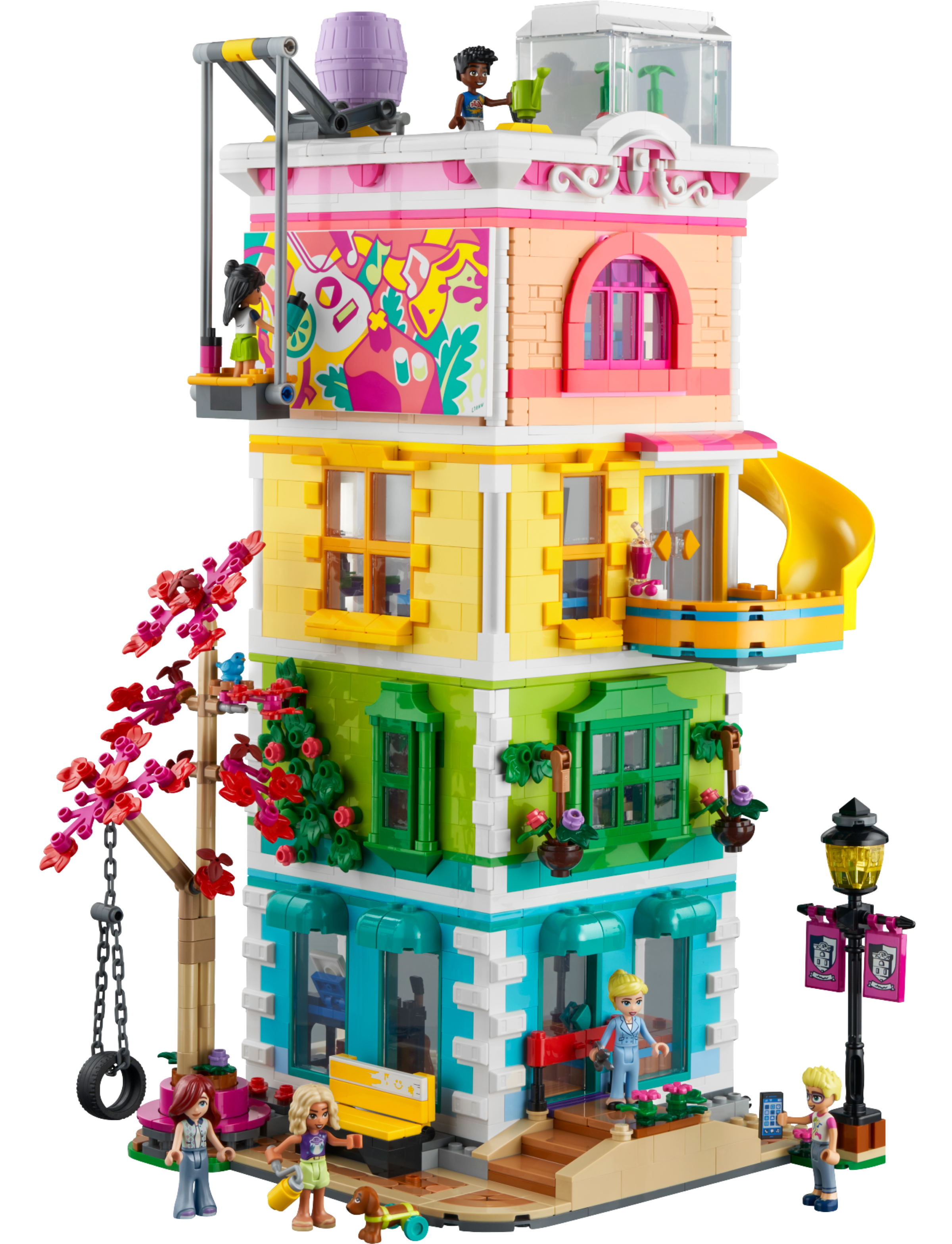
The Minidoll: A New LEGO Character System
One of the most controversial aspects of LEGO Friends was the introduction of the minidoll, a new figure type distinct from the classic LEGO minifigure.

Why Minidolls Exist
Minidolls were designed to:
- Be more anatomically proportioned
- Allow greater clothing and hair variation
- Better represent facial expressions and personalities
- Enable fashion-based and role-play storytelling
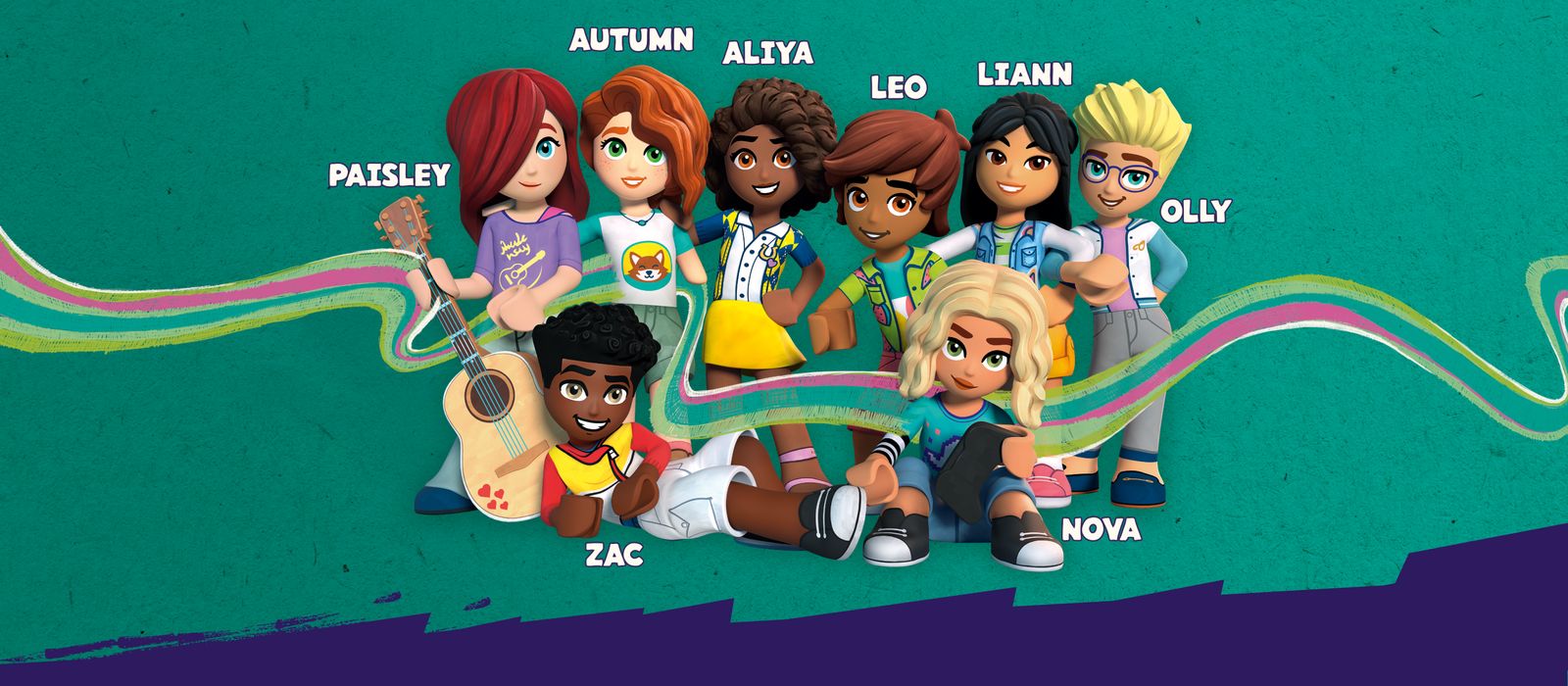
Importantly, minidolls are fully LEGO-compatible — they can sit on studs, hold accessories, and integrate with standard LEGO builds.
Initial Backlash
The early criticism focused on:
- Gender stereotypes
- Colour palettes (pink, purple, teal)
- Body proportions

However, sales told a different story.
Within its first year, LEGO Friends became one of LEGO’s top-selling themes globally.
Meet the Friends: The Original Heartlake Five

At the heart of LEGO Friends were five core characters, each designed to represent a different personality and interest:
- Olivia – Science, technology, engineering, innovation
- Emma – Art, fashion, creativity
- Mia – Nature, animals, activism
- Andrea – Music, performance, confidence
- Stephanie – Organisation, leadership, community

This was intentional. Each character offered a point of identification, allowing children to project themselves into Heartlake City rather than simply reenact instructions.

Heartlake City: A Living LEGO City
What Is Heartlake City?
Heartlake City is the fictional setting of LEGO Friends — a fully modular LEGO city system equivalent in ambition to LEGO City, but focused on:
- Community spaces
- Social venues
- Homes and workplaces
- Nature and sustainability
Over time, Heartlake City has included:
- Schools and universities
- Cafés and restaurants
- Hospitals and vet clinics
- Apartments and houses
- Shopping districts
- Parks, beaches, marinas, and resorts
Unlike LEGO City, which often centres around services and vehicles, Heartlake City prioritises places where stories happen.

Evolution of LEGO Friends (2012–2024)
Phase 1: Establishment (2012–2015)
Early sets focused on:
- Small buildings
- Starter homes
- Cafés, bakeries, and vet clinics
Design was simpler, colour-forward, and aimed at accessibility.
Phase 2: Expansion (2016–2019)
LEGO Friends grew in scale and confidence:
- Larger modular buildings
- Multi-storey structures
- Complex interiors
- More diverse characters introduced
Phase 3: Maturity & Inclusion (2020–Present)
Recent LEGO Friends sets reflect:
- Greater cultural diversity
- Neurodiverse characters
- Environmental themes
- Real-world social topics handled gently
This phase positions LEGO Friends as arguably LEGO’s most progressive theme.
Key LEGO Friends Sets That Defined the Theme

Landmark Sets
While hundreds of sets exist, several stand out as milestones:

- Heartlake City Shopping Mall – A true city anchor
- Grand Hotel – Multi-storey play and display
- Heartlake City Resort – Destination storytelling
- Tree House & Nature Sets – Sustainability themes
- Modern Houses & Apartments – Realistic domestic architecture

These sets demonstrate that LEGO Friends is not just play-scale, but increasingly display-worthy.
LEGO Friends vs LEGO City
| Aspect | LEGO Friends | LEGO City |
|---|---|---|
| Core Focus | Social storytelling | Services & action |
| Characters | Named, recurring | Generic |
| Setting | Heartlake City | Real-world inspired |
| Play Style | Role-play & narrative | Scenario & rescue |
| Aesthetic | Colourful, modern | Neutral, utilitarian |
For collectors and museum curators, this distinction is crucial. LEGO Friends documents everyday life, relationships, and community in a way LEGO City rarely does.
Media, Animation, and Transmedia Storytelling
LEGO Friends expanded far beyond bricks:
- Animated TV series
- Netflix specials
- Books and magazines
- Video games
- YouTube shorts and webisodes
This transmedia approach turned LEGO Friends into a universe, not just a product line — similar in scope (though very different in tone) to LEGO Ninjago.
Who Is LEGO Friends Really For?
While originally marketed at ages 6–12, LEGO Friends now appeals to:
- Children who prefer narrative play
- Families building shared LEGO cities
- Adult fans interested in architecture
- Educators using LEGO for social learning
- Museums curating modern LEGO history
Many adult builders quietly acknowledge that LEGO Friends buildings are some of the best interior designs LEGO produces.
LEGO Friends in a LEGO Museum or City Display
For Redmond’s Forge, LEGO Friends deserves its own space.
Best Exhibition Approaches
- Dedicated Heartlake City district
- Integrated road plates and parks
- Side-by-side comparison with LEGO City
- Story plaques explaining characters
- Family-friendly interactive zones
Heartlake City works exceptionally well as:
- A slice-of-life diorama
- A modern contrast to classic LEGO themes
- A way to engage younger visitors without compromising display quality
Legacy and Importance of LEGO Friends
LEGO Friends changed LEGO forever. It:
- Expanded LEGO’s audience globally
- Proved research-led design works
- Normalised diversity in LEGO worlds
- Influenced later themes and characters
- Helped secure LEGO’s financial growth in the 2010s
Without LEGO Friends, modern LEGO simply would not look the way it does today.
Final Thoughts: Why LEGO Friends Matters
LEGO Friends is not about pink bricks or minidolls.
It is about storytelling, identity, and community.
Heartlake City stands as LEGO’s most human city, one built not around emergencies or villains, but around everyday life.
For collectors, parents, educators, and museums alike, LEGO Friends is no longer optional history.
It is essential LEGO history.